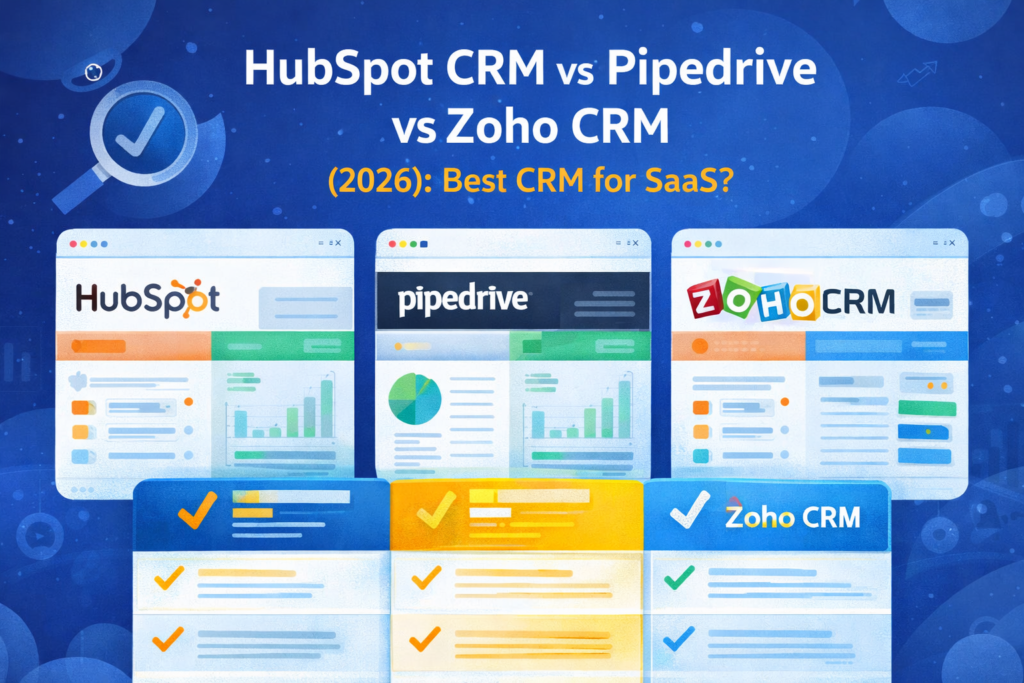
HubSpot CRM vs Pipedrive vs Zoho CRM (2026): Which CRM Is Best for SaaS?
A CRM is the system that turns leads into revenue—especially in SaaS, where deals often involve demos, follow-ups, onboarding, and renewals. But choosing a CRM isn’t about picking the “biggest brand.” It’s about matching your sales motion:
- Product-led SaaS that needs lightweight pipeline tracking
- Sales-led SaaS that needs strong reporting, stages, and automations
- Hybrid teams that need marketing + sales alignment
In this guide, we’ll compare HubSpot CRM, Pipedrive, and Zoho CRM—three popular choices with very different strengths—so you can pick the best CRM for your SaaS pipeline in 2026.
How to Choose a CRM for SaaS (The Non-Negotiables)
1) Pipeline clarity (stages that match your sales motion)
Your CRM should make it easy to track:
- New lead → Qualified → Demo booked → Proposal → Closed won/lost
For SaaS, clarity wins. If your team avoids the CRM, it won’t matter how many features it has.
2) Automation (without creating a mess)
Look for automations that reduce busywork:
- Auto-assign leads
- Deal stage updates
- Task reminders
- Follow-up sequences (or integrations to email tools)
3) Reporting that shows revenue reality
You need clean answers to:
- Which channel brings the best deals?
- Which rep closes fastest?
- Where are deals stuck?
4) Integrations (email, forms, scheduling, support)
At minimum, most SaaS teams connect:
- Email marketing / sequences
- Scheduling (demo bookings)
- Forms + landing pages
- Support/helpdesk (optional)
Internal Links :
Best CRM Software (Hub):
“Want more options before you decide? See our full roundup of the Best CRM Software for Small Businesses in 2025.”
Best Email Marketing Software :
“To nurture leads after they enter your CRM, pair it with tools from our Best Email Marketing Software for Small Businesses in 2026 (Free + Paid Picks) guide.”
Best Workflow Automation Tools:
“For lead routing, alerts, and cross-app workflows, check our Best Workflow Automation Tools for Small Businesses in 2026 (Top Picks Compared) list.”
Quick Comparison Table (2026)
| CRM | Best for | Biggest strength | Main downside | CTA Button (what to write) |
|---|---|---|---|---|
| HubSpot CRM | SaaS teams wanting CRM + marketing alignment | Clean UX + reporting + ecosystem | Can get expensive as you scale | Get Started |
| Pipedrive | Pipeline-focused sales teams | Simple pipeline management | Less “marketing suite” feel | Try Pipedrive |
| Zoho CRM | Value + customization | Flexible + many modules | Can feel complex to configure | See Plans |
1) HubSpot CRM
Overview
HubSpot CRM is often chosen by SaaS teams that want a clean, modern CRM with strong reporting and an ecosystem that can expand into marketing, service, and automation. If your goal is alignment between marketing leads and sales outcomes, HubSpot is a common pick.
Key Features
- Contact and company management with lifecycle stages
- Deal pipelines with customizable stages
- Reporting dashboards for pipeline and performance
- Strong integration ecosystem (forms, email, tracking, etc.)
- Easy-to-use UI that teams actually adopt
Pros
- Very clean user experience (high adoption)
- Strong reporting and visibility for founders
- Scales into a larger platform if needed
Cons
- Cost can rise as you add features/contacts/seats
- Some advanced capabilities may require higher tiers
Pricing
HubSpot typically has multiple tiers and add-ons; pricing varies by needs and scale.
Best for
SaaS teams that want a CRM that stays organized and can expand into a broader go-to-market platform.
2) Pipedrive
Overview
Pipedrive is built for one thing: making sales pipelines easy to run. If your SaaS is sales-led (demos, follow-ups, deal stages), Pipedrive is usually one of the simplest CRMs to keep updated consistently.
Key Features
- Visual pipeline with drag-and-drop stages
- Activities and reminders to keep deals moving
- Custom fields and basic automation
- Reporting focused on pipeline movement
- Integrations for scheduling, email, and workflows
Pros
- One of the easiest CRMs for daily use
- Great pipeline clarity for sales teams
- Fast setup and low learning curve
Cons
- If you want deep marketing-suite features, you may need additional tools
- Advanced needs often require integrations
Pricing
Pricing typically scales by user seats and feature tiers.
Best for
SaaS teams that want a no-nonsense pipeline CRM that sales reps will actually use.
3) Zoho CRM

Overview
Zoho CRM is a strong option for SaaS teams that want flexibility and value. It’s known for customization and the ability to adapt fields, modules, and workflows to your process—especially if you like tailoring systems to fit your exact sales motion.
Key Features
- Customizable pipelines and fields
- Automation rules for lead assignment and follow-ups
- Reporting and dashboards
- Broad ecosystem (useful if you use other Zoho apps)
- Role-based controls for teams
Pros
- Flexible and customizable
- Often a strong value option for growing teams
- Good choice if you need “more control” over the CRM structure
Cons
- Setup can take time (not always plug-and-play)
- UI and modules may feel complex at first
Pricing
Pricing varies by plan level and feature requirements.
Best for
SaaS teams who want customization + value, and don’t mind spending time on setup.
Final Verdict: Best CRM by SaaS Use Case
Best if you want marketing + sales alignment and clean reporting
✅ HubSpot CRM
Best if your team is sales-led and you want pure pipeline execution
✅ Pipedrive
Best if you want customization and value (and don’t mind setup)
✅ Zoho CRM
FAQ ?
Q1) Which CRM is best for early-stage SaaS?
If you want the simplest pipeline execution, Pipedrive is a common fit. If you want a platform that scales into marketing + reporting, HubSpot is often worth considering.
Q2) Which CRM is easiest for sales teams to actually use?
Pipedrive is typically the easiest for day-to-day pipeline updates because it’s designed around the pipeline workflow.
Q3) Which CRM gives the most customization?
Zoho CRM is usually a strong choice when you want to tailor fields, rules, and workflows.
Q4) What should I connect to my CRM?
At minimum: email + scheduling + forms. For automations across tools, see our Best Workflow Automation Tools guide.
Q5) What should I read next on PilotryLab?
Best CRM Software
Best Email Marketing Software
Lead Generation Stack
Zapier vs Make vs n8n:
“If you’re connecting your CRM to multiple apps, our Zapier vs Make vs n8n: Best Automation Tool (2026) comparison can help you choose the right automation layer.”
Best Landing Page Builders:
“Collecting leads? These CRMs work best when paired with high-converting pages—see our Best Landing Page Builders for Small Businesses (2025) guide.”
Best Website Builders :
“If you’re still building your marketing site, start with our Best Website Builders for Small Businesses in 2026 (Tested Picks) roundup.”